Swing Lab
Give driver practice two clear jobs: repeat the setup, explore the release
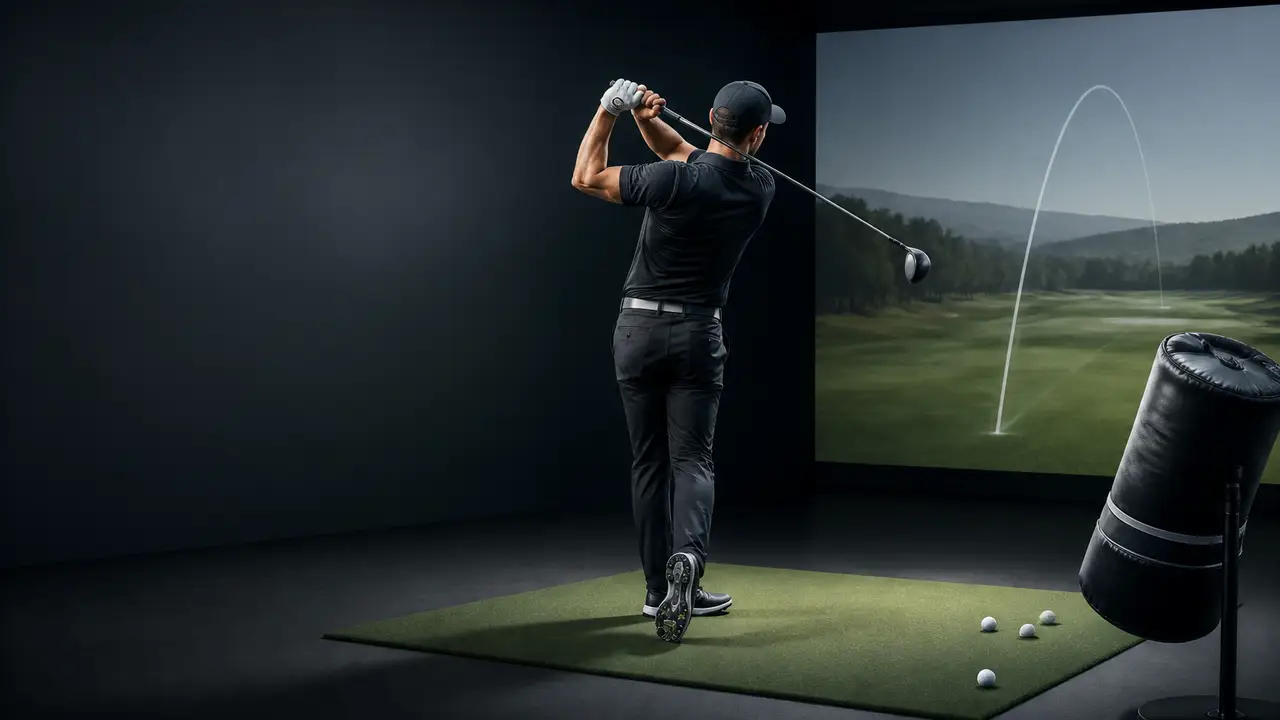
Jason Baile’s walk-in routine and Joe Plecker’s impact-bag demonstration offer two separate ways to organize a focused simulator session.
By Chuck Sports Desk / 2 sources / Published September 13, 2026
A driver session gets difficult to interpret when every ball comes with a different swing thought. Jason Baile and Joe Plecker offer two distinct places to look: how you arrive at address, and how you experience the release through impact.
Their Titleist lessons make a useful pair for a simulator practice session because you can study them separately. Baile supplies a walk-in routine. Plecker demonstrates an impact-bag exercise for release timing. Start by understanding each lesson, then use your own shot pattern to decide what deserves more attention.
Make the walk-in repeatable
Baile begins with the relationship between the rib cage, hanging arms and ball position. For the right-handed setup he demonstrates, Titleist describes a forward bend toward the ball, a small tilt away from the target and a slight rotation left.
His arm references are specific: the right elbow points toward the right hip pocket, while the left elbow faces toward the target. As he walks into the shot, he positions the ball opposite his left armpit, looks toward a chosen launch window, then establishes his stance.
He also explains that his own preferred window sits slightly right because he plays a draw. That is a description of his shot, not a target every golfer needs to adopt. Watch the routine as a whole before choosing which reference to practice.
- YouTube
Hit More Powerful Drives by Setting Up Correctly | TItleist TIps
Open original ↗ In a simulator bay, choose a target and hit a baseline group before changing anything. For the next group, step away after every shot and repeat the same walk-in sequence. Resist the convenience of staying planted over a fresh ball: rebuilding address is the skill this block is meant to rehearse.
Write down your intended starting direction and where the ball actually starts. If you record video, keep the camera position consistent between groups. A useful result may be a routine you can repeat even before you see a change in distance.
Learn what Plecker means by release
Plecker's Smash Station uses a flat impact bag and an alignment rod held in the trail hand. He aligns the bag with the lead-shoulder area and demonstrates how the rod meets the flat surface when the motion is timed as he intends.
The sound is part of his feedback. He contrasts a flat strike with arriving tip-first or dragging the handle forward. He also shows the lead side making room for extension rather than keeping the upper body frozen in place.
This is a demonstration with a separate training station. Its impact bag is not the simulator screen, and the exercise should remain separate from shots played into the screen. The complete video supplies the setup and movement that a short description cannot.
- YouTube
How to Time Your Driver Release for Maximum Extension and Power | Titleist
Open original ↗ If you explore the exercise, use the equipment and arrangement shown, with enough room for the movement. Treat the sound as feedback about that drill. It is not a launch-monitor measurement or proof that a full driver swing is now correct.
Return to ordinary shots for a final comparison. Use the same target as the opening group and keep the setup routine consistent. Note strike quality and direction as well as carry, without chasing the longest single drive.
Your notes should distinguish the two experiments. Did rebuilding the walk-in make address easier to repeat? Did studying the release change the feel of impact? Keeping those questions separate gives the next session a useful starting point.
More from The Perfect Lie